
Machine learning models that anticipate. Anticipate before it happens.
Model families that work on your historical data to anticipate demand, detect anomalies, and plan maintenance, paired with custom models built for your specific scenarios, inside the same Console you already use for AI Agents.
Book a Demo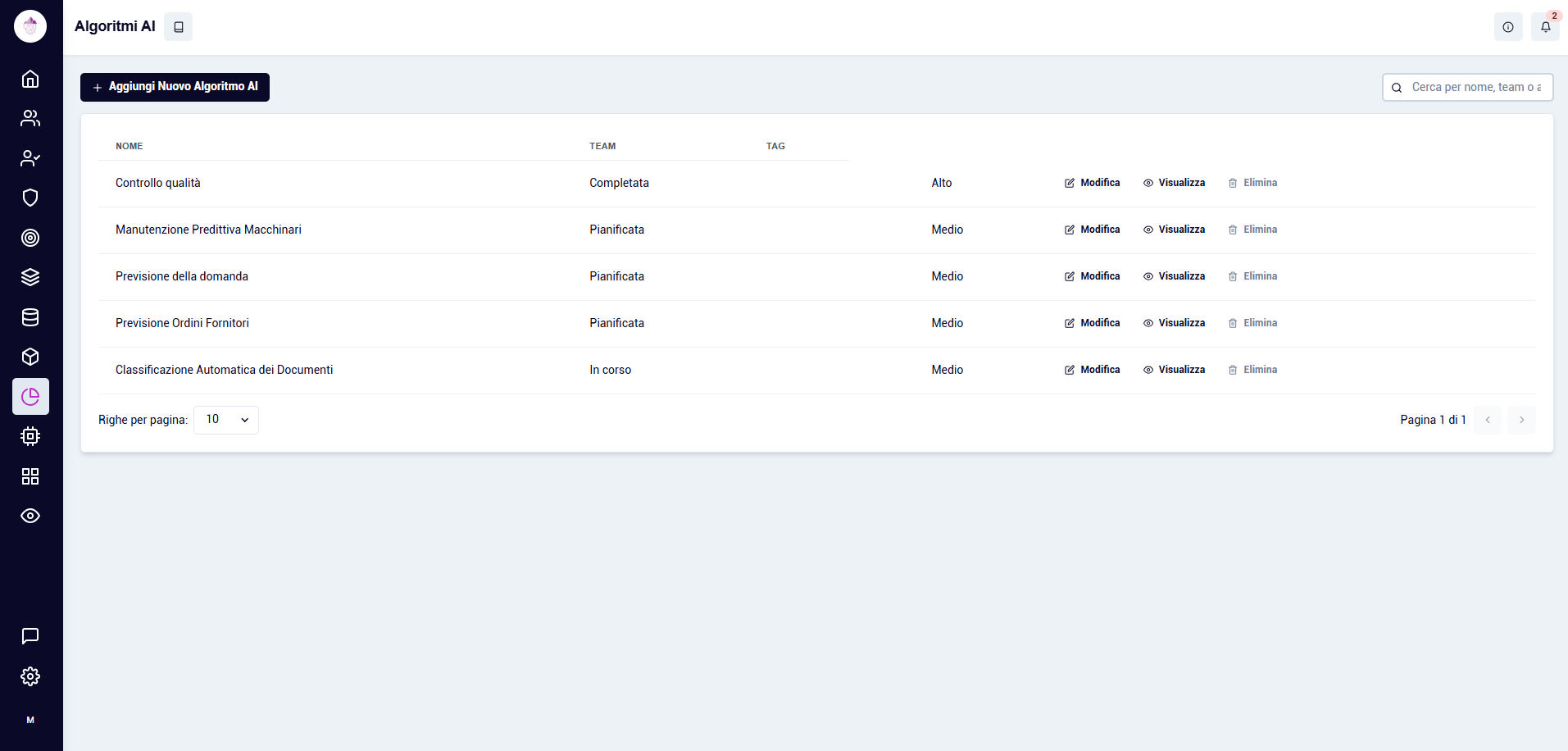
Forecasting, quality, maintenance, and tailor-made models.
Models built for the industrial processes with the highest economic impact, paired with custom models developed for your use cases, trained on your data and running inside your perimeter.
Demand and inventory forecasting
Demand forecasting by SKU, seasonality, and period. Optimal stock level calculation. Smart replenishment. Fewer line stoppages caused by missing materials.
Predictive quality control
Anomaly detection on process parameters (vibration, temperature, scrap rates), with alerts before the batch is compromised. Automatic defect classification.
Preventive maintenance
Models that learn from machine telemetry (current draw, temperatures, vibration) and flag failure risk early, enabling planned interventions instead of unplanned downtime.
Custom-built models
When the use case falls outside predefined templates, our data scientists build ML models on your data and your specific scenarios. Same integration with the Agents, same infrastructure, same perimeter.
Predictive models talk to the Agents.
They are not separate silos: ML Algorithms are a tool that the AI Agents call at the right moment, inside an end-to-end flow.
Example: the Replenishment Agent calls the forecast model.
When the warehouse reports inventory below threshold, the Replenishment Agent queries the forecast model to estimate future demand over the coverage period, calculates the optimal quantity, checks supplier lead times, and proposes the order to the responsible manager. The decision stays human, the analysis is automated.
The same pattern applies to quality control (the Verification Agent calls the anomaly detection model on the line) and to maintenance (the Planning Agent calls the failure risk model on the machines).
Where Predictive Intelligence is already at work.
Textile inventory replenishment
At a textile manufacturer, the forecast model trained on 36 months of sales by SKU delivered a 25% reduction in dead stock and an 8% reduction in line stoppages caused by missing materials.
In-line anomaly detection
On a plastic extrusion line, the anomaly detection model running on process parameters (temperature, pressure, speed) caught 92% of anomalies before final quality control.
Predictive classification
In an administrative back office, the document classification model raised accuracy in automatic routing of supplier invoices from 78% to 96%, with a corresponding reduction in month-end close times.
Preventive maintenance on a fleet
Across a fleet of 40 machine tools, the failure risk model enabled the team to anticipate 80% of unplanned interventions, cutting unscheduled downtime by 35% in the first year after activation.
Actual results depend on the quality of historical data, the maturity of the processes, and the observation period. They are defined case by case during the preliminary analysis.
Anticipating beats reacting.
Talk to an expert to see which predictive use cases can deliver the most impact for your company.
Book a Call